![[Air Conditioning Energy Saving Office Note 12] Difference Between Rated Current and Rated Power Consumption](https://image.mono.ipros.com/public/product/image/2093615/IPROS4841767261656268368.png?w=280&h=280)
[Air Conditioning Energy Saving Office Note 12] Difference Between Rated Current and Rated Power Consumption
Organizing commonly used reference values for air conditioning energy-saving measurements in an easy-to-understand manner.
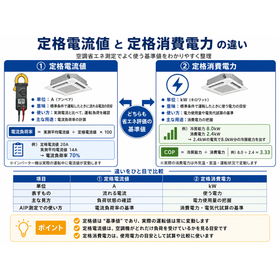
When evaluating the energy-saving performance of air conditioning units, the "rated values" published by manufacturers are an essential standard. However, rated values are merely guidelines under standard conditions and can vary significantly from actual operating conditions. This time, we will clarify the differences in the roles of "rated current value (A)" and "rated power consumption (kW)," which are frequently used in energy-saving measurements, and explain how to utilize them in the field. 1. Role of "rated current value (A)": Visualizing the load on the air conditioning unit The rated current value is an estimate of the current that flows when the air conditioning unit operates under standard conditions. Main use: It is used as a reference value to calculate the "operating load" on the equipment. How to use: By dividing the measured average current value by the rated current value, you can calculate the "current load ratio." Calculation formula: Current load ratio = (Measured average current value ÷ Rated current value) × 100 Note: In the case of inverter units, the current value fluctuates during actual operation, so comparing it with measured data is important.
- Company:AIP
- Price:Other